Thatched Cottage: A Quiet Charm That Stitches True
First Impressions: Heritage, Not Hype
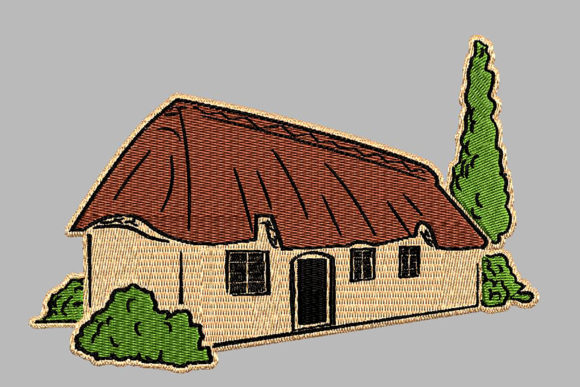
When I opened Thatched Cottage for the first time, I didn’t see just another farm-themed embroidery file—I saw a mood. Soft lines, balanced proportions, and that gentle, slightly asymmetrical roofline speak to real heritage architecture, not cartoonish cliché. It’s peaceful without being sleepy, detailed without being fussy. The design feels like something you’d pause to admire on a country lane—not because it shouts, but because it breathes. That matters deeply when you’re choosing a machine embroidery design for a finished product your customers will hold, gift, or hang with intention.
Real Project Test: A Linen Tote Bag for a Local Farm Shop
Last week, I stitched Thatched Cottage onto a heavyweight natural linen tote—intended as limited-edition merchandise for a small organic dairy’s holiday pop-up. No frills, no backing graphics—just the design centered on the front panel, 4.2" wide. The result? Instant recognition. Shoppers paused, smiled, and asked, “Is that *their* barn?” (It wasn’t—but the emotional resonance was real.) That’s the quiet power of this piece: it reads clearly at a glance, holds warmth in its shape, and feels handmade—not digitized.
Where It Shines (and Why)
- Wall decor & canvas pieces: As the description hints, Thatched Cottage sings when given space. On stretched canvas or framed hoop art, its gentle fill stitch areas read as textured, not flat—and the roof’s subtle layering suggests depth without demanding ultra-fine detail.
- Tote bags & aprons: Its horizontal orientation and moderate height make it ideal for side panels or lower-center placement. No awkward cropping needed—even on curved seams, the cottage’s solid base anchors the composition.
- Baby items & nursery decor: The softness of the silhouette works beautifully on organic cotton onesies or muslin pillow covers. No sharp angles, no aggressive contrast—just calm visual language parents trust.
- Holiday & wedding gifts: Paired with neutral thread (ecru on oatmeal linen, charcoal on cream wool blend), it reads timeless—not seasonal. I’ve used it on tea towels gifted at farmhouse weddings; guests consistently comment on how “settled” and warm it feels.
Where to Pause (Not Panic)
Thatched Cottage isn’t fussy—but it does ask for thoughtful execution. It’s not built for micro-hooped caps or tightly curved visors. The chimney and window details rely on clean satin stitch definition, so avoid thin knits or highly textured burlap without testing. On dark fabric, confirm your thread colors carry enough contrast—especially in the thatch, where subtle tonal shifts matter. And while it handles light stretch (like midweight jersey for a baby sweatshirt), skip it on performance fabrics or anything that puckers easily without proper cutaway stabilizer.
Stitch Density & Fabric Harmony
The fill stitch areas are generous but breathable—not dense enough to stiffen lightweight cotton, not sparse enough to look patchy on canvas. I ran it on a medium-weight quilting cotton with tear-away + light cutaway stabilizer: zero distortion, crisp edges, and a finish that felt substantial, not craft-store-flat. That balance is rare. Many farm-themed designs tip too far into either “too busy” or “too bland.” Thatched Cottage lands right in the middle—making it reliable for both personal projects and consistent small-batch production.
What It Does for Your Craft Business
As an Etsy seller and small shop consultant, I watch what makes buyers linger—and Thatched Cottage earns dwell time. It signals care: in the drawing, in the stitch planning, in the restraint. When you list it as part of a “Heritage Home Collection” alongside matching wheat sheaf or vintage gate motifs, it builds brand cohesion without forcing uniformity. Customers don’t buy a cottage—they buy a feeling of rootedness. That translates directly to perceived value, repeat orders, and word-of-mouth referrals (“You have to see their embroidered tea towels!”).
Practical Designer Notes You’ll Actually Use
- Test on scrap fabric *first*—especially if using textured weaves or dark backgrounds.
- Check thread color contrast in both daylight and indoor lighting. Thatch tones can mute quickly.
- Review stitch density visually—not just in software. Does the roof feel full but not heavy? Does the door read as a shape, not a blob?
- Confirm hoop size compatibility before prepping production runs. This design fits comfortably in a 5x7 hoop, but verify your own workflow.
- Inspect small corners—the chimney cap and window frame hold up well, but always double-check under magnification if stitching for baby items.
- Mock it up in black-and-white. If the silhouette stays legible, you’ve got strong design bones.
- Use appropriate stabilizer: cutaway for knits, tear-away for stable wovens, fusible for lightweight linens.
- Verify licensing terms before selling finished products or bundling as digital embroidery files—this is non-negotiable for commercial embroidery use.
Farm, Yes—but Far From Generic
Yes, Thatched Cottage lives in the Farm category—but it avoids every trap of the genre. No roosters crowing, no over-simplified tractors, no forced cheer. It’s quieter, older, more considered. That’s why it works across contexts: as a personalized gift stitched onto a child’s backpack, as boutique branding on a chef’s apron, or as a signature motif for a heritage seed company’s packaging. It doesn’t shout “farm”—it whispers “home.” And in today’s handmade market, that whisper carries further than any shout.
Final Thought: It’s Not Just a Design—It’s a Delivery Vehicle
Every embroidery file you choose is a silent ambassador for your skill, taste, and values. Thatched Cottage delivers consistency, calm, and quiet craftsmanship—without asking for perfection from your machine or your fabric. It’s the kind of embroidery file that makes customers say, “I *had* to have it,” not because it’s flashy, but because it feels true. And in the world of handmade product, that’s the highest compliment—and the strongest sales signal—you can get.